June 2026 Newsletter
Understanding how the adult brain regulates plasticity may unlock an entirely new generation of neuropsychiatric therapies. In this issue, we explore the emerging role of perineuronal nets (PNNs) – extracellular structures that help stabilize neural circuits – in neuropsychiatric disease.
Science in Sixty Seconds
What are Perineuronal Nets?
The adult brain is far less malleable than the developing brain. This shift is not a coincidence, it’s actively enforced. With over 3,000 specific cell types, which includes neurons (the communicators) and glial cells (the helpers), the brain needs a mechanism to tell it how and when these cells need to work together to promote plasticity (Siletti et al. 2023). Perineuronal nets (PNNs) are a crucial part of this system.
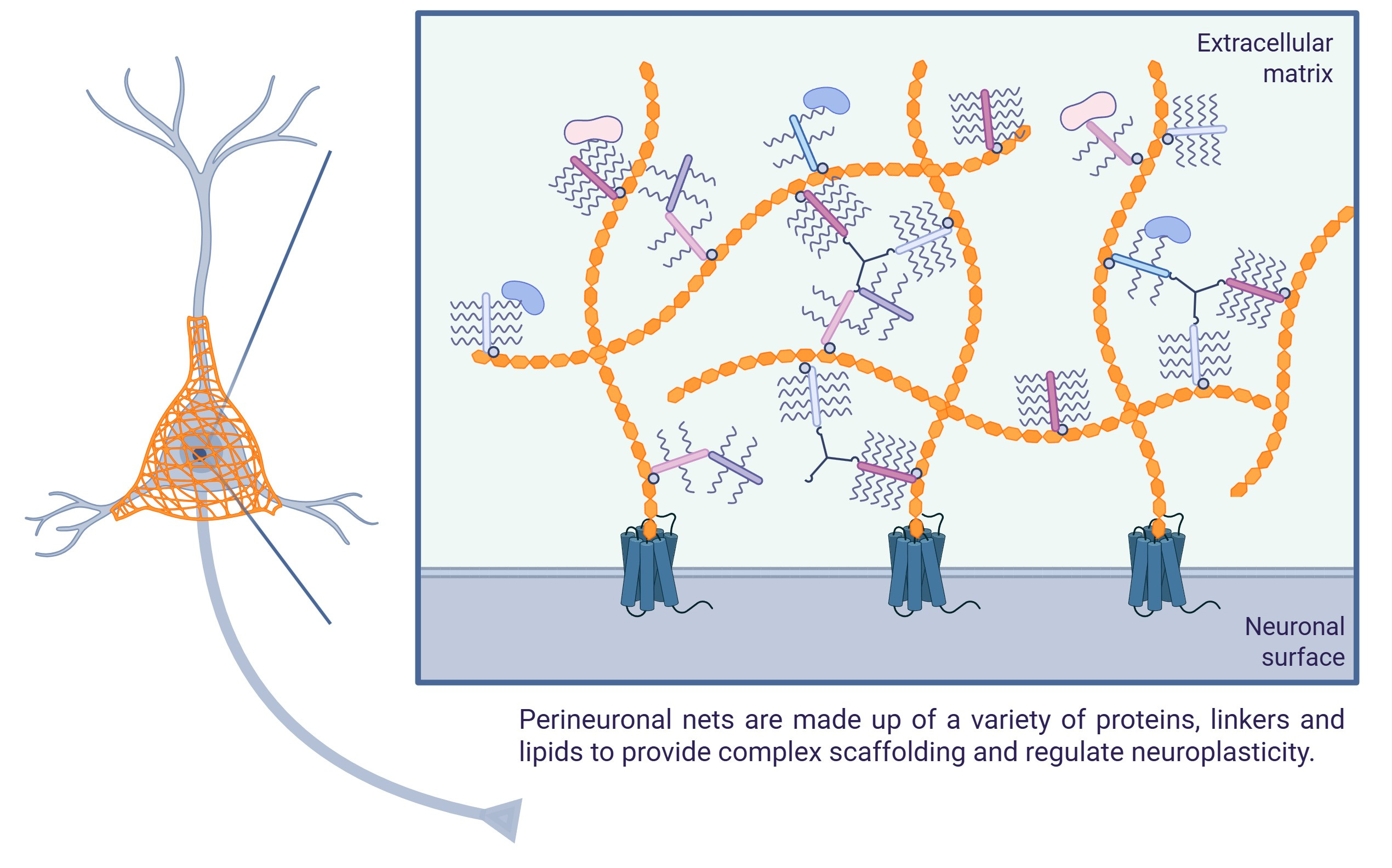
PNNs are specialized structures situated within the extracellular matrix (ECM) occupying intercellular spaces in the central nervous system. PNNs are made from various proteins and provide extra support for neurons throughout cortical and subcortical brain regions (Figure 1). Their appearance in the cortex is linked to maturation of parvalbumin-expressing neurons, a specific type of cell that is implicated in balancing excitation and inhibition, and regulating critical periods of brain plasticity (Lasek et al. 2019).
The Role of PNNs in Learning and Memory
PNNs are formed during brain development at different times depending on the brain region, but have been linked to critical periods, which are time points when key developmental milestones take place (Auer et al. 2025). PNNs are directly involved in this process, as they provide a netting around the neurons and allow for specific connections between other neurons, promoting these developmental milestones. If the PNNs are not there to facilitate these connections, other outcomes can occur. One of the most studied critical periods in humans is the formation of normal binocular vision and it has been demonstrated that raising animals in complete darkness from birth prevents the formation of PNNs in the adult visual cortex (Pizzorusso et al. 2002).
PNNs aren’t only involved in visual development, but are thought to be part of the adaptive response of the brain to different stimuli and environments. Various studies have demonstrated PNNs contribute to memory storage, consolidation and cognitive flexibility (Banerjee et al. 2017; Happel et al. 2014; Gogolla et al. 2009). Disruption of these processes has been implicated in several psychiatric disorders including anxiety, post-traumatic stress disorder, depression and addiction.
For example, relapse in addiction has been linked to deeply embedded memories related to past drug use. PNNs in the brain’s reward center appear to lock these associations in place through determining which neurons communicate. When researchers dissolved the nets in this region, cocaine-seeking behavior in rodents dropped significantly (Slaker et al. 2019). The implication: some of what makes addiction so hard to overcome may be structural, not just psychological.
Can specific treatments unlock PNNs?
Some research has found that these critical periods that are often linked to early development can be re-opened in adulthood in attempts to harness this hyperplastic state.
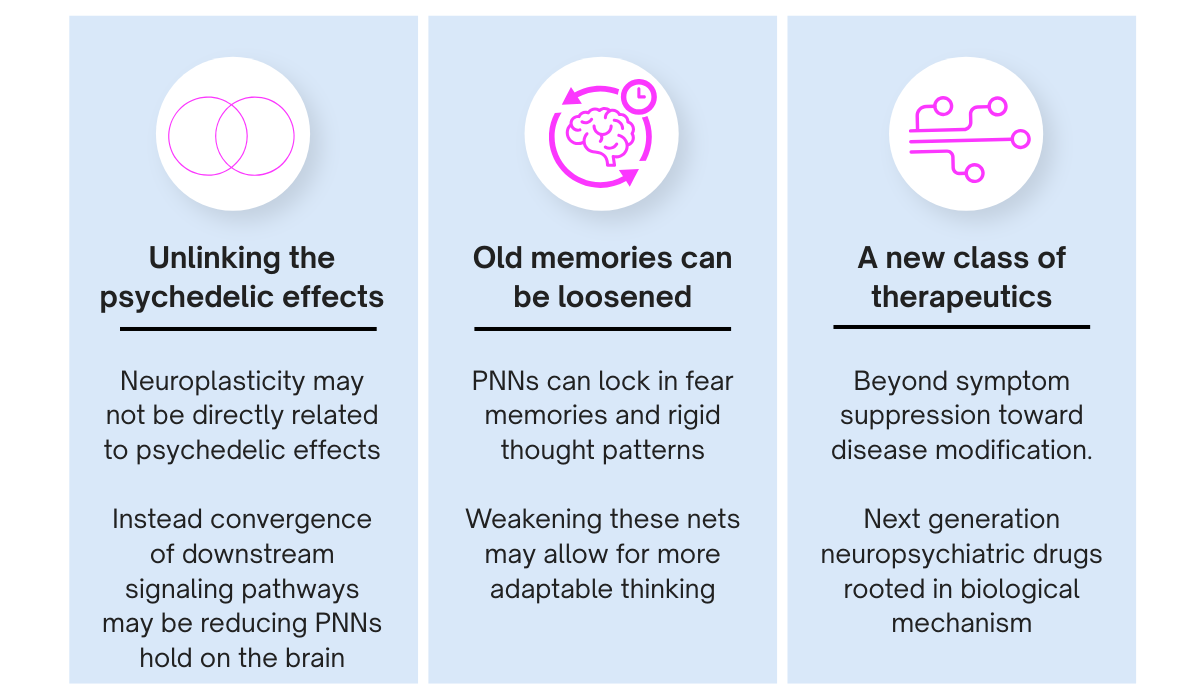
A 2023 paper by Nardou et al. showed evidence that several psychedelics (LSD, psilocybin, ibogaine and ketamine) can induce a state of social reward learning thought to be a re-opening of the juvenile critical period. They hypothesize that the convergent mechanism of these compounds is downstream remodelling in the ECM, where the PNNs gate plasticity. While they didn’t directly assess PNN changes, they did find changes in gene expression related to the ECM structure (which is where the PNNs live).
Recently, a pre-print by Acuña et al. has assessed how PNNs are involved in psychedelic-induced critical periods. They showed adult animals treated with ibogaine that have undergone visual deprivation in one eye (monocular deprivation) have reduced visual acuity and a reduction in dendritic spine density (a measure of neuronal plasticity). They looked further into the mechanism and found ibogaine also reduced the PNNs in the visual cortex, possibly allowing for this type of plasticity.
While just the beginning of these investigations, this framework has some exciting implications for how we think about novel treatments:
Why this matters for Xylo Bio
At Xylo Bio, we believe the most transformative treatments for mental illness won’t just change how people feel in the moment – they’ll alter the brain’s capacity to change itself.
Our platform is designed to identify and develop compounds that engage these plasticity mechanisms with precision: the right target, in the right circuit, at the right time. Because when the brain is ready to change, the right intervention can make all the difference.
XYLO BIO UPDATES:
Collaborations and Thought Leadership
- Dr. Banister presented on a well-attended panel titled “Neural, Immune, and Behavioral Interactions of Psychedelics and Stress” at the ASPET Annual Meeting.
- Dr. Banister and members of ASPET participated in a day of service with People Serving People to assemble snack packs and support families experiencing housing instability.
- Samantha Rector (VP of Business Development) had the honor of giving the Keynote for the UW-Madison School of Pharmacy Graduate Studies Program Commencement.
- Dr. Sam Banister (Co-founder and CSO) participated in the Blackbird Sunrise Series AFTER DARK event, discussing what it takes to build a business.
- Co-founders Josh Ismin (CEO) and Dr. Sam Banister (CSO) attended a reception for the Endless Frontiers Program in NYC.
In Xylo Bio’s recent Targeted Neuro Talks, Dr. Sam Banister chatted about the 5-HT1B receptor, a less investigated serotonergic target, with Dr. Kate Nautiyal:
Coming Up:
Find members of the Xylo Bio team traveling in the coming months:
- BIO International Convention (June 22 - 25, San Diego, CA) - members of Xylo will be attending.
- 9th Neuropsychiatric Drug Development Summit (September 15-17 Boston, MA) - Dr. Sam Banister (CSO) will be presenting on the intersection of AI, drug discovery and neuronal biomarkers.
Photos

RESEARCH UPDATES: Science Shaping the Future of Neurotherapeutics
This month’s emerging literature demonstrates the same principles driving Xylo’s strategy: mechanism-guided design, rigorous biological investigation and clinically scalable innovation.
Preclinical Research
- Functional connectivity predicts synaptic stability in the hippocampus | This study assessed the same neurons over 2-weeks to determine the relationship between functional and structural plasticity. Using optogenetics in awake mice, they demonstrate stronger synaptic connections in the hippocampus are linked to larger, more stable dendritic spines. Spines that showed stronger calcium signaling in response to stimulation persisted longer over time, suggesting that synaptic strength helps determine which neural connections are maintained. Nat Commun.
- Anti-depressant effects of TMS have a cell-specific mechanism in the PFC | Using a mouse model of repetitive transcranial magnetic stimulation (aiTBS) researchers identified cell type–specific circuit mechanisms underlying rapid antidepressant effects in the prefrontal cortex (PFC). The researchers found that aiTBS drives plasticity through intratelencephalic neurons rather than pyramidal tract neurons in the dorsomedial PFC, linking changes in local circuit function to accelerated antidepressant-like behavioral responses. Cell.
- Psilocybin produces distinct behavioral outcomes across sexes | This study examined the effects of a single psilocybin dose in male and female mice and found that psilocybin produced sex-specific and time-dependent changes in social behavior and dopamine signaling. Female mice showed increased huddling, novelty-seeking, and later preference for familiar social interactions, while males showed altered grooming and reduced dopamine responses to social novelty. This adds to growing evidence of sex differences in psychedelic outcomes. Neuropsychopharmacol.
- Serotonin transporter plays a role in psychedelic-like activity of 4-MeO-MiPT | Researchers aimed to understand the role of the serotonin transporter in mediating psychedelic-like effects of 5-HT2AR agonists. Focusing on compounds like 4-MeO-MiPT and related analogs, they found compounds with stronger SERT inhibition produced weaker psychedelic-like behavioral effects in mice, despite still strongly activating 5-HT2ARs, suggesting that dual 5-HT2A/SERT activity may reduce acute hallucinogenic effects. ACS Chem Neurosci.
- SSRIs produce changes in gene expression related to neuroplasticity | This study used spatial transcriptomics to examine how SSRIs alter gene expression in serotonin neurons within the dorsal raphe nucleus, a major serotonin-producing brain region. In mice, both acute and chronic fluoxetine treatment produced widespread, region-specific transcriptional changes, including altered expression of 5-HT1A autoreceptors and signaling pathways involved in neuroplasticity, such as MAPK, Ras, and cAMP signaling. Mol. Psychiatry.
Clinical Research
- Neuropsychiatric disorder heterogeneity urges for more individualized medicine | This study explored biological heterogeneity in psychiatric disorders across 445,000 individuals. They found patterns of brain and blood-marker variability often do not align neatly with traditional diagnostic categories.The most heterogeneous traits were related to glucose metabolism, suggesting a role in glucose dysregulation across disease. The findings support a move toward more biologically informed and individualized approaches to understanding and treating mental disorders. Nat Commun.
- Psilocybin + psychotherapy shows feasibility in cocaine use disorder | In this randomized clinical trial, adults with cocaine use disorder (N=40) received either a single dose of psilocybin plus psychotherapy or placebo plus the same psychotherapy, and the psilocybin group showed more cocaine-abstinent days, higher rates of complete abstinence, and a lower risk of relapse over 180 days. JAMA Netw Open.
- MRI study identifies possible biomarker for responsiveness in OCD treatment | This neuroimaging study (n=93) examined whether baseline brain connectivity patterns could predict response to the SSRI sertraline in people with obsessive-compulsive disorder (OCD). They found that connectivity within the brain’s sensorimotor circuit differed between patients who later responded to sertraline and those who did not, with connectivity between the right thalamus and posterior cerebellar showing particularly strong predictive value for treatment response. Neuropsychopharmacol.
- Psychedelic-naive adults experience psilocybin-induced brain changes | This study examined the effects of a first high-dose psilocybin experience in psychedelic-naive adults (n=28) and found both acute and longer-term changes in brain activity and structure. During the psychedelic state, psilocybin increased brain entropy and these changes predicted greater psychological insight and improved well-being one month later. Nat Commun.
- LSD induces white matter structural changes in MDD patients | In this clinical trial, patients with major depressive disorder (N=61) received either low-dose or higher-dose LSD, and brain imaging was used in a subset of participants (N=35) to examine changes in white matter structure. The higher-dose LSD group showed increased connectivity-related white matter measures in several brain regions, and these changes were associated with sustained improvements in depressive symptoms over up to 12 weeks. Cell Reports Medicine.
Editorials and Reviews
- Experience-dependent rapid structural changes in the human brain: A systematic review | This systematic review examines evidence that the human brain can undergo measurable structural changes within hours. Across 30 MRI studies, rapid changes in gray matter measures and diffusion signals were observed following learning, stress, exercise, and pharmacological interventions, particularly in regions like the hippocampus and motor cortex. The authors note that some of these effects may reflect transient changes in blood flow or fluid balance rather than permanent structural remodeling, highlighting the need for more precise multimodal imaging approaches. Neurosci. Biobehav. Rev.
- Innovation in treating obsessive-compulsive disorder will not solve the care gap | This BMJ editorial argues that while new treatments for obsessive-compulsive disorder (OCD) are advancing, innovation alone will not address the major gap in access to effective care. The authors emphasize that many people with OCD still lack access to evidence-based treatments like exposure and response prevention therapy, despite OCD being a highly disabling condition associated with increased mortality and suicide risk. BMJ.
- A critical review of brain entropy as a biomarker of the psychedelic state | While many neuroimaging studies show elevated entropy, a measure of the diversity or unpredictability of brain activity, during psychedelic experiences, the authors in this review argue that these changes are not unique to psychedelics. They discuss how results vary depending on how entropy is measured and do not necessarily map directly onto subjective conscious experience. Overall, the paper calls for more rigorous and multidimensional approaches to understanding how psychedelics alter brain activity and consciousness. Neurosci. Biobehav. Rev.
- Psilocybin-Assisted Therapy for Adolescent Anorexia Nervosa: Clinical Considerations and Emerging Models of Care | This review explores the potential use of psilocybin-assisted therapy (PAT) for adolescents with anorexia nervosa, which often begins in adolescence and is associated with high rates of chronic illness, medical complications, and mortality. The authors discuss how psilocybin’s ability to induce neuroplasticity, cognitive flexibility, and emotional processing via 5-HT2A receptor activation could help target the rigid thought patterns and maladaptive reward processing seen in anorexia while emphasizing the need for careful developmental safeguards, family involvement, enhanced consent procedures, and ongoing medical monitoring in younger patients. Curr Psychiatry Rep.
- Adjunctive Antipsychotics in Major Depressive Disorder: A Systematic Review and Network Meta-Analysis | This systematic review and network meta-analysis analyzed FDA-approved atypical antipsychotics used alongside antidepressants in major depressive disorder across 22 studies (N=10,962). Lumateperone showed the greatest antidepressant efficacy, followed by aripiprazole, while aripiprazole had the best overall acceptability and tolerability profile. The findings suggest that atypical antipsychotics differ meaningfully in effectiveness and side effects, which may help guide individualized treatment selection for depression. JAMA Psychiatry..
Clinical Trial Registrations
Below we highlight some of the newer clinical trial registrations via clinicaltrials.gov.
DT-101 (AMPA receptor positive allosteric modulator) ) | Major Depressive Disorder (N=118) | A Study to Evaluate the Effectiveness of DT-101 as an Adjunctive Treatment in Patients With Depression (AERON-1) | Sponsor: Draig Therapeutics Ltd | NCT07610473
Esketamine + Electroconvulsive Therapy (ECT) | Major Depressive Disorder (N=130) | Multimodal Pharmacological Study of Clinical Cohorts for Major Depressive Disorder | Sponsor: Shanghai Mental Health Center | NCT07602153
DT-120 (formerly MM120; LSD) | Major Depressive Disorder and Insomnia (N=25) | A Phase 3 Trial of DT120 for Major Depressive Disorder (Ascend) | Sponsor: Definium Therapeutics US, Inc | NCT07592689
Jump back to:
- Science in Sixty Seconds – Exploring the last year of neurotherapeutics
- Xylo Bio Updates – Company news, progress, and highlights
- Research Updates – Summaries of recent studies shaping the field
Thanks for reading Xylo Bio’s Neuroscience Newsletter! Subscribe to stay informed.

.webp)